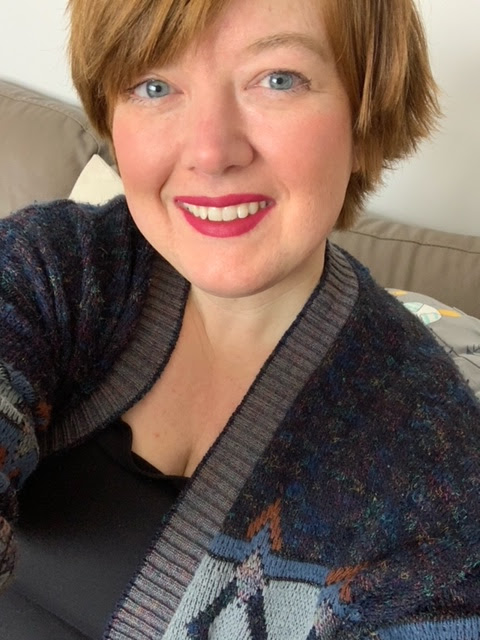
Sunday, November 24, 2024

On Your 44th Birthday

 On your 44th birthday, nothing will go as planned. You'll wake to find your four year old feverish and miserable, dooming those Disney on Ice tickets. You'll scramble to find a duo to join your husband and daughter at the show and sigh with relief that one piece of your birthday puzzle can continue, even if you won't be part of the experience. While father and daughter watch Elsa and Anna and Moana, you'll be snuggled beside your firstborn, who rarely sits still long enough for cuddles. 

You'll watch The Wild Robot twice and at the part where Roz helps launch Brightbill into the sky, worried she'll never see her adopted son again, you'll feel tears creep along the edges of your lashes. 

"This part always makes me cry," you'll say.

"Why?" he'll ask.

"Because she loves him so much."

And he'll smile and nod.

He won't eat the crackers you bring him in a bowl and instead he will request something soft and you will offer to make brownies. It'll be a ploy, of course, a box of protein powdery brownies to trick him into a bit of sustenance. He'll agree and you'll bake what will be your birthday cake, adding chocolate chips to entice the patient. After three bites he will curl up and say, "that was good, I'm done." Starve a fever, right? So you won't push it, opting for apple juice and you will wonder if you should ask your husband to stop on the way home for popsicles, more juice, more tylenol. You'll forget all those things and it will be fine.

Your parents will call, sad for your change of birthday plans, asking about their grandson and his fever. Your mom will muse about what she was doing 44 years ago and you'll agree that post-C section memories are fuzzy 2 years later, much less 44. Your parents will tell you they love you and you will believe them, as you always have. 

Later, from his sad bundle of blankets, with Mr. Fox under one arm, your son will ask for lunch. And when you ask what sounds good, expecting something simple and sickly and sad (maybe applesauce), he'll say, "barbeque chicken and waffles." So he'll be fevered and tired but you'll be happy to have him briefly stand on the chair beside you in the kitchen while you microwave some chicken and he pours some barbeque sauce and proudly mixes his creation. He'll ask for extra honey for his waffles and you'll be proud to know he, like you, prefers honey over syrup. 

Your little sister will call and wish you, "Happy Birthday" and you'll discuss a raincheck for shared birthday festivities, nobody wants a fever. You'll remember, as you always do, that she is your favorite birthday present.

When your daughter gets home she'll proudly give her brother the light up toy (Maui's hook) she picked out for him at the show, which will cost a mere $40. You'll share raised eyebrows with your husband, who was suckered into this Disney on Ice adventure weeks ago, and he'll admit it was fun. 

You'll open presents from your little family, the purse you wanted from your husband, and gifts from son and daughter that your son picked out earlier in the week. Cozy socks you'll wear as soon as you get out of the shower, a sparkly pink Christmas ornament, and a necklace of "jewels" that you know you'll treasure. It's the first time your son will have chosen a present for you and he will be adamant about this specific necklace and you do love jewels (and rocks that look like jewels), and you'll be touched your son knows this about you. 

Your little brother will call on his way to pick up your niece at play practice. "She'll be our thespian," he'll say. And after well wishes and birthday teasing you'll discuss Christmas and the likelihood that one of our boys will sport a black eye by the end of the holiday since we'll be giving my nephew a hockey set and our son an archery set. And you’ll remember, as you always do, that you get to parent alongside your baby brother, though he's hours away, and it will make you smile. 

You'll hug your husband in the kitchen while your elderly dog begs to be fed for the fourth time. "Do dogs go senile?" you'll ask, and you'll make a note in your phone to ask the vet about her growing confusion. She's a good girl, tired, and losing her eyesight, and you'll save that sadness for a day that is not today.

You'll order supper from the Thai place your sister likes and after spring rolls and Tom Kha with enough of a kick to make you cough just a little bit, you'll sit down with your daughter and a bundle of stamps. Your daughter who used to say so little, who struggled to hear and understand, she'll now point to a chair and demand, "sit here, Mama." One by one, you'll pull stamps from her bag and she'll delightedly exclaim, "Fower! Cake! Know-fake! Cockodile! Xylophone!" and the "xylophone" will be your favorite because the stamp is not a stamp of a xylophone, it's a stamp of eighth notes. Little minds are so quick, so exuberant, musical notes are a xylophone, Mama! 

A skipped nap for your daughter, a fever for your son, means they'll both be in bed before 8, a rare event. And you will make a cup of tea using the tea kettle that whistles like a harmonica, a gift from your late uncle that he begged you to return ("I didn't know it whistled like a harmonica, that's ridiculous," he said). You'll have a slice of protein-laden birthday brownie (baked in a cake tin because you couldn't find your square 8x8, brownies just aren't meant to be pizza-shaped but it will be okay) and you will thank God for this sweet little life and this particular trip around the sun. 

Monday, May 13, 2024

BigHeartBabyHeart


My daughter takes her time. She is cautious with her steps, deliberate with her words. Despite some pathologies thrown around ("gross motor delay" for the walking hesitance, "speech delay" for her silence), I've always felt she was, more than anything, her own perfect person. Maybe other parents of more than one child have had the experience of raising children who seemed similar, who achieved milestones at a similar pace, or had familiar personalities, but my experience has been the opposite. Johanna is beautifully, wonderfully herself, and that has forced me to be patient, which, if I am honest, is the fruit of the spirit that I am least likely to cultivate. Unless it's for her. 

Over the last several months we've been going to speech therapy once a week. Sometimes it's me, sometimes it's her dad, but it's a weekly reminder that, so far, she has been quieter than her brother.  There are all sorts of reasons why that might be. Perhaps her incessant ear infections have made her hearing a bit muffled at times. Perhaps the noisy nature of her big brother has left her with the impression that he'll do the talking for both of them. Or maybe she is just waiting. 

Like my first born (and I am also a first born), words come easily for me. They always have. But more than that, I've also frequently used words as a crutch. I've been witty when I should have been careful. I've been aggressive when I should have been kind. I've used my ease with words to get what I want, when I want it, and I've hurt people with my words, too. So as I've gotten older, and especially as I've had children, I've tried to be more deliberate with my speech, more exacting, and I've tried to listen with the same passion with which I speak. 

Many of the speech therapy tools are about waiting, giving Jo room to use her voice, applauding her for each new sound. She understands far beyond what she can tell us, that much is obvious. And we wait for that understanding to take shape, burst forth, tumble out behind a laugh. And in the meantime, we do all the things you do with small children. We run and chase and pretend and play in the sandbox. And we draw. 

Jo loves to draw and over the last few days she has said, "Mama" and pointed to the chair next to her while she colors. She gives me a marker and says, "heart," and I dutifully draw a heart. My habit is to draw a midsize heart and we talk about the color (purple tonight). After that, she says, "big heart," and I flip the page over and draw a heart that barely fits within the space. She grins broadly and then points beside the heart and says, "baby." I draw a small heart beside the big one and she singsongs, "big heart baby heart" and we both laugh. Sometimes she points at the big heart and says, "Mama" and I point to the baby heart and say, "Jojo." And sometimes she just scribbles away and mutters "bigheartbabyheart" as I chase marker tops on the floor. 

She is pure joy, beloved and my last baby. So waiting for her to speak also feels like I'm asking her to grow up, which I'm loathe to do. But I'm also anxious to understand her chatter, to hear the stories she tells her dolls, the fibs she tells her brother. All the speech milestones are pretty logical, stringing words together, forming short sentences. We've had a few ("mine now" is important in our house). But my favorite thus far, by far, is Big heart, baby heart. It's a gloriously full, complex, poetic genius of a sentence. And it's hers. 

Monday, April 08, 2024

The Table and Little Hands

 I was raised in a Southern Baptist family and attended Southern Baptist churches into my young adulthood. While I do not consider myself Baptist any longer, there are certain rules/interpretations of church practice that have remained with me, namely around baptism and communion. With each of these sacraments I'm raising my children in a way that differs from how I was raised. It's a heady thing, to attempt to explain God and faith to children, it feels heavy and impossible on good days, more heavy and more impossible on bad ones. 

I grew up with the concept of "being Saved," a phrase that was part of every sermon growing up. It was a question asked and answered. When were you Saved? I was Saved at such-and-such on such-and-such date. How does one become Saved? One asks Jesus to come into one's heart. As a child this seemed logical enough although I do remember wondering how I was supposed to know when was the right time to make that invitation. I knew I loved God. I knew John 3:16 by heart. I was a champ at Bible Drill (that's competitive Bible quizzes for those unaware that such things exist). But when kids in my Sunday School class were celebrated for asking Jesus into their heart, I was always tempted to ask how they knew it was time. I never did ask anyone. But on my Dad's birthday in 1989 we attended a Billy Graham crusade not far from where we lived in Little Rock. I remember very little of that experience except the feeling during the altar call that it was Time. Rev Graham had invited anyone making a profession of faith to come down the stadium stairs to the field. I turned to my Dad and said something along the lines of, "I'm going down." I remember he asked if I wanted him to come with me and I said I was ok. Looking back he may have regretted that as he watched his 8 year old daughter descend the steps. But he found me a few minutes later, sitting next to a volunteer, and his smile felt like the brightest sunshine. I was baptized a few weeks later after conversations with my parents and pastor. Only then was I able to participate in communion, an event that occurred quarterly at my church.

The church we attend now holds communion far more frequently, weekly during special seasons like Lent and Advent, and a couple times a month when we're not in those seasons. As such, communion feels both more and less special. It feels more holy, more deliberate, more powerful because it is such a frequent component of our worship, it's something we share as a community and so it feels truly foundational to our time together. And it also feels less special, not in terms of its import, but because it is so frequent, so embedded in our worship fabric, it feels expected and established, a comfort. When I was taking communion in Baptist churches, because it was less frequent, it always had an air of mystery and (I cannot find another word) superiority. I remember feeling like a grown up, separate and apart from my unbaptized friends, because I now got to take a cup from the plate passed around. I got to tuck that little plastic vessel in the perfectly sized hole at the back of the pew. I had done something, I had believed. 

I do not think I was wrong as a child. I know that what I felt at that stadium in Arkansas was holy and beautiful. I know that the anticipation of participating in communion was itself holy and beautiful, because it helped me begin to understand what it means to participate in a sacrament, even if I was never taught that word, sacrament. I know my parents and pastor delighted in my growing faith and wanted nothing more than to point me continuously toward my Heavenly Father. I want to do the same for my children. But the truth of it is, my children will grow up differently. They will not be taught that a specific, identifiable moment of "Saving" is the goal, although I fully believe that is how many people first experience their relationship with Jesus. They will instead be taught about the continual grace, continual saving, continual joy of the Resurrection, a journey that began, at least as far as worship practice, the moment they were baptized as babies.

And that brings me to the real inspiration for this post: my toddlers sometimes have a piece of bread during communion and my Southern Baptist self feels things about that. Both Chester and I have strong Christian parents from more conservative worship practices and when the kids receive a blessing, eat their little piece of bread, Chester and I frequently glance at each other with the "our dads would not approve" grimace and half-smile. 

Chester is a better Bible scholar than I am so when I asked him what exactly (somebody is a lawyer) the Bible said about communion, he pointed me to 1 Corinthians, where Paul says "Whoever, therefore, eats the bread or drinks the cup of the Lord in an unworthy manner will be guilty concerning the body and blood of the Lord...". I don't discount Paul's perspective, but I also don't hold his words higher than Jesus's own, "Take, eat; this is my body." "Do this in remembrance of me." So what could be unworthy? Can a 3 year old participating with his parents be unworthy? If baptism begins the journey in the life of the church, isn't participating in communion at different stages of maturity also part of that journey? 

Chester and I discussed and decided on a plan. A 3 and 2 year old are too young for the discernment Paul preaches, but they are not too young to understand quiet, prayer, love, gentleness, importance. They're not too young to feel part of a whole, folded into the family of a church. They are members of this church, baptized into this beautiful community, and we want them to participate in the ways that make sense to their developing minds.  So whenever we celebrate communion Chester and I eyeball each other. Is this a good Sunday for them? Are they listening? If so, we will tell them, "we eat this bread and drink this juice to remember Jesus." And we will hold their hands as we walk down the aisle and afterwards we will say, "I love you, Jesus." This won't be every communion service because they're still 2 and 3. Sometimes the best we can do is to get them into the church, maybe read a book about Noah, coax them into eating fewer than five donut holes. But sometimes they want to go with us when we take communion, sometimes their bodies quiet ever so slightly as they listen to the music, sometimes they point to a painting of Jesus and say his name. I fully believe the Holy Spirit moves in children, and I believe the table is large enough for little hands. 

Because our kids will likely attend a Catholic school in our neighborhood and because they have Catholic and Baptist and conservative Lutheran family members, they'll grow up with different perspectives on communion. And that's okay. They'll ask questions, some of which Chester and I will be able to answer, and some of which we won't. They'll grow in all the ways children grow and someday they will be old enough to decide when and if they walk down a church aisle and receive the bread, the cup. They will have days when they feel unready or unwilling to participate, days and whole seasons when they question whether they believe in this God their parents taught them to love. But in the midst of those seasons, my prayer is that they will never question that the table is laid for them, prepared for them, that they are continuously invited to remember Jesus and the blood He shed for them, not because of anything they did or words they said, but because of everything Jesus is. 

"Because there is one bread, we who are many are one body, for we all partake of the one bread." 1 Corinthians 10:17


Monday, October 02, 2023

Junior


Junior was a gift for my third birthday. I don't really remember what he looked like brand new though I do remember him being taller than me at the time. Today, he is a deflated teddy bear missing an eye, replacement nose crafted from a scrap of leopard print sock. He's stuffed with those pinhead styrofoam beads, the ones that cascade out of the tiniest hole and stick to everything. As a kid, I threw him against the wall when I was angry and sobbed into him more times than I'll ever be able to remember. For years he was being patched together almost monthly and there are threads in some version of brown in sloppy stitches on each extremity. 

He was a gift from my beloved Uncle Kevin and over the years he would tease me that Junior was still around. He drove me to college one year, Junior perched in the backseat, and marveled that his gift was so well-traveled. On occasion he'd ask how Junior was doing, and I'd reassure him that he was doing well, staying out of trouble. When I bought my first home, I took a picture on my front step with the one-eyed fellow and sent the picture to Kevin. Junior has outlived him by several years now. I sobbed into Junior when we found out Kevin had cancer. And years later, after my husband's shirt was suitably soaked by my tears, I cried into Junior when Kevin died. I cried into him when we had our first miscarriage and punched him hard enough to split a seam with our second loss. The bear has absorbed some grief. 

He's also my childhood bear, my keeper of secrets, the reliable comrade who propped me up when I was sick and where I rested my head on many a late night phone call with my best friend. After I married I had a real, live human to cry into, to rest against, and Junior saw fewer tears and cushioned fewer naps. Even more so, when I had children, the complete wildness of my days meant I'd often forget when I showered last, much less made the time to lean my head against Junior and read a book. If I'm honest, while I had hopes that my children might one day love him, I assumed that was an ill-placed hope. They'd have their own dear stuffed friends, their own once-new toys that should, appropriately, be tasked with weathering their own lives. I propped Junior in my son's bedroom corner and tasked him with oversight. 

But Junior has surprised me with a second life. For the last several months, he has laid, smashed and deflated as ever, on the floor by my son's bed. He is, once again, where I lay my head, but now it's for the purpose of singing Twinkle, Twinkle for the 75th time. I'm not sure when he moved over to that perfect spot. I'm sure my husband or I grabbed him one night as the nearest soft object upon which to lay our heads while we prayed for the toddler to close his eyes. And he has remained there, the perfect cushion at the end of a long day. 

A few nights ago, after books and blocks and lots of singing, I laid in the dark listening to my son breathe. My chest hitched, that hiccup of emotion you get when you feel too much too fast. My son was growing, his breath already sounding older than I was ready for, and my head rested on the bear Kevin gave me at his age. I breathed then like my boy breathes now, and at his size my arm wrapped around Kevin's impractical and perfect gift. Kevin, who my babies will not know this side of Heaven. It hurt. But it also radiated, vibrated with knowing. Knowing how delighted Kevin would be to see that ridiculous bear, still holding strong at 39, cushioning my head as I sang his great-nephew to sleep. 

"How's Junior doing these days?"

"He's doing well, staying out of trouble."

Wednesday, August 16, 2023

Angry Welts

My daughter has a patch of skin at the base of her neck, always pink, sometimes enflamed, sometimes bearing scratch marks from tiny fingernails. At almost 18 months old, this is the last of her stork bites, the others having faded into that perfect skin. And this one may not be a true stork bite, since it's frequently irritated, and may lead us to a pediatric dermatologist for laser treatments. On most days it doesn't bother her, but there are days it looks like the angriest of welts and my own neck tingles at the sight. 

Maybe it's motherhood or maybe it's just me-hood, but sometimes I am so caught up in her bumps and scratches and milestones that I forget to feel the sheer joy of her. I'm busy googling eczema creams and when-do-allergies-start and when-do-I-need-to-worry-that-she-isn't-talking-much. I'm busy buying detangler because her baby hair is finally thick enough to snarl, worrying that the brush I'm using is a bit too hard for that sweet scalp. I'm consumed by correcting the tiny portion of the world I can control, hoping that feels like love to her someday. 

But. The base of her neck will keep itching. Her new shoes will cause blisters. She'll bump her head on the dining table. And still she thrives, tears replaced quickly with that quizzical eyebrow scrunch, as if she dares the world to get in her way. She is a tank, in the dearest way. She plows through every anxiety I dream up, pummeling her big brother with a force that surprises us both. She is fearless when she wants to be and I like to think she gets that from me. 

So I'm trying to feel that fearless joy more often than the ache of anxiety. Angry welts, bumped heads, diaper rashes...all these discomforts when she's so new to this life, and still she cackles when she chases her brother, grins when I ask for a hug. The speed with which she rebounds is astonishing. There is no time for tears when there is a world to explore!  I know the discomforts won't always be minor, won't always be problems I can fix. So for now, I'll enjoy the power I have to soften the world around her, treat her discomforts, and smooth her path. Angry welts are no match for Mama. 

Wednesday, November 16, 2022

Truman Builds Houses

 The inspiration for this poem is Truman's months-long obsession with houses. What are you drawing, Truman? House. What are you building, Truman? House. He's two and our home probably feels like his whole world. But I can make a metaphor out of anything so it also feels like the genius of childhood, recognizing how essential feeling "at home" is for our happiness, and how innate the craving for home in our understanding of love, of God. Making our house Truman and Johanna's home continues to be the joy of a lifetime.

Sometimes his blocks are unsteady, built for speed

but even the tower in Pisa began its days straight.

It was one of his first perfectly-formed words - House

His voice confident, powerful, small, and yet, great.

He builds slowly when it suits him, when the day feels easy

When the ground is solid, the air warm, houses are pure joy.

Sometimes it is daddy's house, mama's house, rarely sister's

He is an architect, an explorer, a destroyer, a little boy.

What shape a house takes when its creation is delight

When the beams lean against the hips of a mother

What comfort warps itself into these spaces, these sturdy and less sturdy walls

When the hand that shapes them crafts only life, only love, only color.

What a gorgeous, Godly world it could be if he built it

All passion, joy, hilarity, and the "watch Mama" yelled loud

How lovely a seat for Jesus, for Esther, for David, for Mary

All welcome, all laboring, all celebrating, all marveling in Truman's house.

Sunday, September 25, 2022

The Weight of You

https://drive.google.com/uc?export=view&id=1NDTv4BAEPE0ofY3U7rBNbgQrxjAcqmihNot long after getting married, I saw a picture online of a baby, maybe 9-10 months old, a sweet, smiling baby with dark hair and a few new teeth.  In the picture, she was being held aloft by two feminine arms, and the crease in the woman's wrist haunted me throughout my pregnancies. I ached for that crease in the wrist, that weight of a life being swung overhead.  Before Truman was born, I felt that ache like a wound, especially with a pandemic surrounding us, two previous miscarriages.  I worried I'd only know the ache, never the weight of a child in my arms. After he was born, that ache was replaced, for a time, with joy. But pandemic fears, the hustle and exhaustion of new motherhood, I didn't savor the weight of him in those first months. I was desperate for him to be bigger, stronger, to feel less fragile in what felt like an increasingly dangerous world. 

You're different, my girl. You sleep less soundly than your brother, smile more often, and I do not hope for time to speed up the way I did with him. I am not the same woman I was when your brother was born. I am less scared, more hopeful. These last few months since your birth, I've held you, lifted you above my head, felt your perfect weight against my wrists, and thanked God for the miracle of you and your brother. I have treasured you better than I did your brother at this age, and that has allowed me to cherish you both more fully. 

I still think of that picture, still remember that empty ache as I waited to meet you. The weight of you in my arms has rooted me into my own life in a way nothing ever has.  The disappointments of the world lose a bit of their sting when I balance you on my hip, your tiny fingers gripping my hair. And in those rare, precious moments when you rest on one shoulder and your brother on the other, I know I hold the whole world in my arms. Thank you, Johanna, for the crease in my wrist. 


Saturday, February 06, 2021

The Story of a Sweater


I remember my Grandfather as a large man, tall with a slow, loping stride. I remember him with a wide grin and long arms, a man with many books on shelves I was too short to reach.  He died when I was 18, the spring of my freshman year at college. A few months before he died I rode the bus from school in Virginia to my grandparents' home in Columbia, South Carolina. Even though cancer had weakened him, he still seemed big to me, I still felt small in his arms. 

Over fifteen years later, I was back at that house, this time to spend time with my Grandmother over a long winter weekend. It was bizarrely cold for South Carolina and Grandmother's fuse box quit on us.  All the lights in the house stopped working, the heat stopped working, but a few random outlets and the stove and fridge continued to function, like some Southern angel knew you couldn't rob us of the kitchen on top of everything else.  While my uncles made calls to electricians, I made trips to Lowe's for firewood and Bojangles for biscuits. On my way to the house I'd stopped at the grocery store for soup ingredients as I was determined to stock Grandmother's freezer with soup.  So with the fridge and the stove being the only functioning appliances in the house, we ended up spending the majority of the weekend in the kitchen, Grandmother sitting at the table wearing Grandfather's sweater and me by the stove making batches of soup. We'd play Scrabble and argue over the rules and we'd talk about my work, my dog, my boyfriend, and whether or not I had enough quilts at my house. 

I picked up an extension cord at Lowe's and at night I'd run the extension cord from the functioning kitchen outlet up the stairs to her room where she had a space heater. We'd run that for a few hours tow arm up her room and then shut it off when we went to bed, both of us a little gun-shy about the safety of the outlets at that point. "Let's not burn the house down," she said. I'd snuggle into my bed under a pile of quilts and come morning I'd walk downstairs wrapped in blankets to start the coffee before going back upstairs to Grandmother's room.  On that first cold morning she told me to get in bed with her as soon as she saw me not wearing any socks, it was too cold to not be wearing socks.  I laughed and got in bed and we talked for a few minutes.  The only other time I remember being in bed with my Grandmother was soon after my Grandfather died.  I spent my spring break with Grandmother that year and I have very few memories of that week, we were both so sad.  One afternoon I found her crying, sitting on their bed, and I went and sat beside her and cried, too. Then we took a nap, one of those sad naps where you sleep so deeply it feels like your heart just turns off for a while. 

After the power was restored our weekend was spent discussing the power having gone out, and what an adventure that was.  The mornings were still chilly and, seeing me rub my arms, Grandmother insisted I put on Grandfather's sweater. It was a London Fog wool blend, the kind you can tell used to be very scratchy but through diligent wearing had been worn thin and soft. It was grey and blue with buttons so weathered I couldn't tell their original color. And as I slipped my arms inside, I expected this sweater to swallow me, this sweater of this larger-than-life, grinning marvel of a man. But it didn't. It fit me just fine, the arms a little long, but fine. Ah, I thought, so Grandfather was a normal human size, I suppose. Just the size of a man. And now my shoulders aren't that much smaller than his. 

Despite our adventure, Grandmother was still Grandmother and I was still me, so by the end of the trip I'd grown testy. I loved her but our relationship was sometimes hard and sharp. We had a stupid fight when I left, one of those idiotic rows you immediately regret. Though we forgave one another by the time I drove away, gave hugs and kisses and exchanged I love yous, I still felt awful for that ugly tension at the end of my visit.  Grandmother never brought up that argument. When she spoke of our weekend of powerless cold, the way I filled the house with smoke the first time I started a fire, the way I packed her freezer with soup, the way we went to Bojangles for biscuits and coffee to warm up, she only described it as a grand adventure. And a few weeks after I got home I received a box with my address written in her perfect, Grandmotherly script. In the box was Grandfather's sweater and $5 to buy myself a lipstick. 

I don't wear the sweater often but it's a good Saturday sweater. A sweater for bitter cold. And, like Grandmother, I hang it in my closet when I'm not wearing it. I see it everyday. I see Grandfather, still large and long-armed, asking me if I want to hear a joke. And I see Grandmother, bent over her Scrabble tiles at her kitchen table while I stir the soup. I miss them. I wish they'd known their great-grandson. But I hold him and watch his tiny hand grab these weathered buttons, and they feel close. 

Monday, January 25, 2021

The Whole World

Babies are conquerors. They blaze into a home on a wave of glory and milk and lay claim to every inch of a life. For several of those early weeks after Truman came home from the hospital, he slept in a pack n play tucked behind the couch and Chester and I would take shifts sleeping beside him while the other cobbled together four or five consecutive (!) hours in our bed. Over time we moved him to a bassinet in our bedroom, his sleeping coos and grunts and whistles inches from my face. My bedside table was a mess of burp cloths, breast pads, and vaseline. It has been amazing, and at times disconcerting, seeing how much space this tiny person can occupy. Every room has been commandeered by him in some way, every corner dedicated to some aspect of babyhood. 

He is only six months old. He has only taken up physical room for half a year (a bit more if we count the space he used to take up below my ribs). But already the landscape he has altered is changing.  After months at my bedside, we moved him to his crib, and the bassinet is no longer a shadow along the wall when I'd wake at night, listening for his breath. It's in the basement now, filled with a hodgepodge of baby gear, accoutrements we've already outgrown: too-small diapers, nipple shields, the bottles we never used, the swing he hated. 

The rocking chair and foot stool that occupied the corner where I'd pump multiple times a day has also been retired. The pump tossed, having done its six months of service, and the chair moved to Truman's room. The pack n play will be swapped soon for a bigger playpen, packed away for post-Covid adventures or maybe a sibling someday. 

After we moved the rocking chair this afternoon I held Truman as he surveyed the room and his face settled on the space where I used to sit with my pump. I have no clue what he thought but he notices change these days, his eyes rest more sharply on things that surprise him, things that appear in a new location, the space where a Christmas tree used to be, or a foot stool.  This home is his whole world. Planet Earth is just this address, with infrequent visits to not-too-distant satellites inhabited by family. When the tree is taken down, the rocking chair replaced, the new rug unfurled, he notices. He smiles.

Covid has made my own world feel small, even suffocating sometimes. I think one of my deepest reflexes is to reach. It isn't always a conscious impulse, but I think I have always and will always be grasping something in the distance. And that has often translated into a need to leave often, a need to go elsewhere, explore. And Covid has taken that from me. So I've had to reach here, in my own space. I've had to reach for my husband, my baby, books, the sweat on my Peloton bike, the knitting needles, the pen. I'm not sure I would have ever fully appreciated this space had I not been robbed of every means of escape. And so the space feels changed to me, too. Perhaps in the same way as the relocation of a chair or the taking down of a Christmas tree. Altered, repurposed, refreshed. My whole world. And I feel my heart linger on the change, the contentment, the joy, the way I imagine Truman's mind lingers on the shadow cast by the new high chair. I smile.  


Friday, December 25, 2020

The Best Year


 On the first day of this year we knew enough of you to dream of you, knew enough of you to buy tiny socks, start a list of names

The spring went slow, tears, and the world contracted and grew small while some strange disease crept in, and still you grew, and I did the same

Summer was hot and you were active, resting only when I walked, and so I walked and walked and walked, and wondered what it would be like to walk with you

You were born fighting a battle we couldn't see, life wrapped 'round your neck three times, I've never been able to think long on that, I hope you'll forgive my inability to imagine life without you

Since you joined us the world caught fire, more disease, more fear, more worry for what the future will bring

But hope, too. And green grass to lay you down in, tiny toes with tiny toenails flexed to feel the tickle, wind to cross your cheek as you swing

So few have held you. We've had to tell you of their love, promise that they smile behind each mask, that they pray to God and saints on your behalf, that there are hugs to look forward to.

It has been a year of weeping, of exhaustion, of loneliness.  But it has been the best of all things, too, the deepest of all joys, the wildest of all loves. It has been milk and sweat, the weight of you in my arms, the perfect curve of your smile. It has been the best year, this year of you. 


Saturday, November 21, 2020

Scares

 A couple months ago, upon inspecting a freckle at my hairline, I felt a deep, insistent nudge to get it checked. The freckle had been there for ages but recently appeared darker.  Were I not a new mom, I might have ignored that nudge. I might have chalked it up to too much time in the sun and a need for new bangs. But the dependence of a tiny person made me worry and that worry may have saved my life. 

The melanoma was thin, removed with a 45 minute procedure that was more stressful than painful. The only lasting effects are numbness in my scalp, which should fade over time, and a scar nobody will notice but me.  The days waiting for pathology results were the worst, wondering if I'd need another procedure, wondering if the cancer had spread, wondering what stories my husband would tell our son if I died before his first birthday. 

It was enough of a scare to make life feel more precious, even in the middle of this exhausting pandemic. Even isolated, even without the ready comfort of family and friends, even though Truman has only been held by his aunts and uncles with masks on, even though every day feels like a long Tuesday, even in this slog life feels holy. 

There's a part of me that always struggled with the idea of motherhood because it seemed like a state of being that required full dismissal of self. As in, I'd no longer get to be Rachel because henceforth I'd have to be Mom. But the reality is more nuanced. I see him and I think, "I exist so that you exist." My ambition has been tempered by his smile. Work no longer feels like a goal in and of itself, but a means to an end and he's the end. I still enjoy the way I get to use my brain,  but I prefer to think of him and not solar subscription agreements. But that doesn't feel like a loss of self, just a new alignment of priorities. And the scare of the last few weeks, the scabs largely gone, the scar pinking up and smoothing out, reminds me that every breath of that existence, his and mine, is a gift. 

Thursday, September 03, 2020

My Son

I've stopped and started this post a dozen times.  I'll blame that partly on the demands of a newborn but the truth is writing about my son has felt very heavy.  Heavy in the sense that there's too much carried to lift any one brick for evaluation. The breadth and depth of motherhood (not to mention experiencing motherhood in the context of a pandemic) has swallowed me, made words float far away on a surface I can see but not quite touch. Even my prayers have been stunted, short and desperate (help him grow! protect him! help me!), pleas have been all I could muster under the twin burdens of terror and euphoria. 

While pregnant with Truman, even after he started routinely kicking me in the ribs, his existence seemed tenuous, like any morning I might wake up and it would have all been a dream.  With each week I allowed myself an incremental addition of joy, knowing I was closer to feeling him in my arms.  But even at the hospital, pacing and wincing and generally terrifying my husband, Truman still felt like a cloud of hope, a puff of smoke that a stiff breeze could dissolve. He didn't feel solid until he was placed on my chest after surgery. I couldn't lift my arms on my own and the combination of drugs and hormones made me shiver violently, my teeth chattering as Chester and the nurse helped me hold him. He was warm and sleepy, exhausted by his ordeal, and the first sensation I felt as I regained feeling in my arms was his tiny, wet breath. He was here and real.

Today brought the first breaths of autumn, a brisk wind racing between sunbeams, and as we sat outside Truman would inhale sharply, then smile, when the wind rustled his hair.  I have never felt more firmly tethered to a place than I did in that moment, watching my son feel his first windy day, my feet in the grass of our backyard, my fingers smoothing the edge of his blanket. We exist together, my son and I, his father beside us. Our hearts beat and we feel the wind blow and we watch the leaves make shadows. He is here and real, and I get to love him for the rest of my life. 

Wednesday, March 18, 2020

Fragile

I have rarely lacked confidence in my ability to get things done. I have a healthy stockpile of self-doubts, but my ability to act and decide and plan and put plans in motion is not one. This has served me well in many contexts. It has made me a good lawyer, a good provider, a good payer-of-debts. It has helped me help others and fix problems big and small.  I am a developer of Plans of Attack and a checker of all the boxes. But pregnancy in a pandemic has shattered everything.

I know from experience that pregnancy, every pregnancy, feels disorienting.  On Monday your body is your own.  On Tuesday it is shared sacred space. We've been here before. Twice before. And while those pregnancies ended, they were long enough to disrupt what I could and could not believe about my body.  They were long enough to love someone and lose someone. They were long enough to love and hate what was in the mirror. They were long enough to be surprised by how resilient our flesh can be, suffer and still wake up whole, suffer and still wake up and go to work, suffer and still go to happy hour, suffer and still hope.

After losses, pregnancy feels especially tenuous. My only experience of pregnancy thus far has been destruction and loss, so to be in this new world of good news, healthy ultrasounds, kicks and somersaults after supper, feels beautiful and fragile. To know he's a boy, growing into a boy body, with boy elbows and knees in my stomach, means there's so much more to imagine and cherish, so many daydreams of dirt and baseball and laughter and boat rides, so much more to be lost. He is pictured, not more loved than his lost siblings, but certainly more concrete. He is possible and probable, and that makes the risks loom larger.

But he is an anchor now, too. We cannot drift too deeply into any sea of despair because there are bassinets to research, child care options to discuss.  There are nurseries to daydream and names to debate. We may be isolated, a bit stuck, and bruised by the disappointments and fears of this current storm, but we are constantly reminded by a tiny person we love that the future must come, too. And he doesn't care if Mom doesn't have baby showers, or if the new house isn't quite put together, or if he even has a "new" house to come home to in the first place. He'll just be here. We love him for just being here, just existing. And that love is not fragile, it is fierce.

Tuesday, October 15, 2019

Something to Talk About

I'm new at my job. Unsurprisingly, I'm frequently making my way to the printer and end up exchanging pleasantries with folks who don't know me.  Those initial conversations are frequently awkward, so polite as to be ridiculous, but that's the dance we do in new spaces. Because I started this job while going through our second miscarriage, I was more sensitive to some of those getting-to-know-you questions and I was struck by the fact that only women with children asked me if I had children. It was frequently one of their first questions, and perhaps it always has been.  Perhaps it's only now, when we're trying for and losing our babies, that the question lodges somewhere painful and leaves a mark.

I will say, first, that for whatever reason, the second loss has been easier than the first.  Easier in that I knew what to expect, understood what I was feeling, and had a learned timeline of events.  It was not emotionally easier, but I definitely functioned better. No catatonic evenings on the couch writing drippy poetry and sipping whiskey. I'll partly credit the new job for that high functioning sadness but I'll also credit the weird, wonderful resiliency of human experience. But that doesn't lessen the hitch in my breath, feel the hollowness of my answer, "no, no children." I am an excellent actress, so no need to assume this is painful for anyone other than myself. I am slick and clever and any discomfort can be easily sidestepped with a quick reference to lawyer antics, my newest kitchen gadget purchase, or a comment on somebody's fabulous shoes. 

That's fine. Really. I understand the weirdness of meeting and investing in people, asking questions, picking and prodding to determine points of shared interest. We do so desperately want to connect with people and questions are how that information frequently makes its way to us. But I think it's the expectation of the question itself that I find difficult these days. I don't doubt that mothers want to know if there is shared experience there, a shared bond, working mom to working mom, and that's certainly a valid connection to hope for.  But I wish we didn't start there. I wish that wasn't the first of the getting-to-know-you questions.  Because I am positive that I will not be a more interesting person if/when I become a mother. I will never be of more value than I am right now. My worth, vitality will not increase. I will love someone new, cherish someone I've longed for, but I've actually experienced those things before. I could talk about my husband that way. And if you'd spoken to me before I met him, I could have spoken similarly about members of my family, dreams, goals, travels. My mind, my heart, my relationship with the world, they do not become more worthy of interest or bond or connection when I can add "mother" to my list of descriptors. I am wholly myself today and will be wholly myself forever. 

Women without children never struggle here, they don't ask if you have kids. I don't ask women if they are mothers when I meet them.  And it's not because I don't care, it's because their motherhood isn't a key piece of information for me in determining how I will connect with them.  Because motherhood is not something we will link arms over, we have to find other areas to connect. Books, school, autumn, a shared love of americanos with vanilla syrup, travel daydreams, cars in the shop.  I am aware of my increased sensitivity these days but the questions surrounding children feel very much like an audition with some women, as if my choice of monologue is under scrutiny and the cast list won't be posted until Friday. I think it's this assumed lack of invitation, this knocking on the window of a club I'm not invited to, that scratches the wound. Because so frequently after I say I don't have kids, the conversation falters. Even if I joke and bring up my adorable dog.  Even if I ask to know more about the children, what grade, what sport, there's a languishing there and I feel not a little bit left in the cold. 

While we've begun the adoption journey, we don't know how/when that road will end. I wish, in meeting women, we could connect as friends,  as colleagues, as athletes on side by side spinning bikes, as lovers-of-Jane-Austen, as mutual haters of the office copier, as owners of the same leopard print sweater, and leave the do-you-have-kids questions for days, weeks, months down the road.  I wish for many things, and this is one. 


Monday, August 12, 2019

Castles on the Wall

The Castles hung in his den, which we rarely used. They hung in the room we awkwardly crowded into years ago, that first Thanksgiving after his diagnosis, when we weren't sure how much time we had but we worried the time we had was short. It was too formal a space for our typical Thanksgiving banter and debate and storytelling and worry. But it felt like the room we were supposed to be in.

If I ever noticed the Castles before he died, I don't remember that moment. They're a striking pair, beautifully framed, original paintings of castles to which we have no familial ties. Perhaps he mentioned them to me at some point, asked me if I'd ever been nearby, seen them in person. I'm not even sure if they still stand, perhaps the paintings themselves are pictures of ghosts, Cornwall must be bursting with not-important-enough-to-maintain castles.

We wandered the house after he died, knowing that every thing in its place would soon not be in its place any longer. Couldn't we just keep the house a bit longer, just let it rest, let it miss him? The half-hearted pointing and, "yeah, I guess that might look good in our second bedroom" rings so loud, achingly hollow. I don't want the damn end tables, I want him here. But I guess if they're just going to be sold to someone who doesn't know who they belonged to, hell, yes, I want them.  At least I know where those end tables sat, wooden bookends to the couch we all loved. I know the (not my style) lamps that sat on top of them. I know whose crossword puzzle was tossed there.

I have always been surrounded by him here.  When I bought the house he sent me gorgeous, impossible to fit anywhere mustard colored chairs, a blue ceramic lamp that now sits beside my couch, a mirror that probably cost more than our bed. On birthdays and when I got married he filled the house with pots, pans, kitchen gadgets. Even our collection of coffee mugs has his imprint. Knowing my husband's fascination with Waffle House, he gifted him with a holiday Waffle House coffee mug for Christmas. The thought in that mug still destroys me. I keep it tucked in the back of the cupboard so its presence doesn't wreck me unawares on a Tuesday.

But those things were deliberate gifts. He touched them, decided they were ours. The Castles are only here because I chose them. They are beautiful, and they watched us eat Thanksgiving  turkey, heard our prayers for healing (and for each of us, if not out loud, "if he can't be healed, Lord, at least give us more time than we deserve"). They're prettier than anything else we own on these walls, they're more sophisticated than we are, and they do not belong here.  They belong in his house, in the room we didn't use.  They should be hanging on those walls, an occasional conversation piece but largely forgotten, pictures of ghosts.

They will never be my Castles. They are simply more than I find myself desiring, they're lovelier, older, more impressive than I'd elect. And that makes sense, because they belonged to a man who was more than I deserved. More faithful, more generous, more loving, more kind. And while his choice in art was more classically lovely than I'd choose for myself, he also gifted us with Waffle House mugs, so the pretty inherent in all of his things holds little pretension. The Castles now hang just above our dining table. We don't have a room that goes unused because this home is 890 square feet. There is no den to tuck the prettiest of things, even the prettiest of things have to mingle with the hand-me-downs and Target clearance in this house. But they hang where we pray before supper. They hang where I sometimes work from home, laptop angled to the windows. They hang where we host friends, where we make decisions, where we lay out our passports before traveling. They hang where we live and their prettiness fits in well here, in our new Life Without Uncle Buck. It's a life that misses him, speaks to him, hears his "hey sweetheart" so damn clear, and it's a life that now has Castles on the wall.


Saturday, May 11, 2019

A Roof

Several weeks ago I lost two people, my uncle and  my baby. The losses are married in my gut because they happened so closely in time, days apart.  It's hard to unwind where one pain ends and the other begins, if the tears are for one or both or all or everything. I remember saying to my mom at some point in the process of both losses, "it's too much." She agreed, of course, it is entirely too much. On their own, each loss would have felt unbearable, but the two together feel as if I've broken some internal meter for fortitude.

The last few weeks have blurred, smiles and laughter and warm meals with friends a welcome balm.  But I still feel bizarrely scooped out, like the strongest, worthiest, most-myself-est pieces have been removed for maintenance and I am just a roof, pulled taut over the remaining bits and pieces that make me a person.

I have many in my life who pray for me. My family, friends. And I would never dismiss the desire loved ones have to bring the heartaches of their dearest companions to God.  I'm thankful for prayer, for the messy attempt we humans make of offering comfort when comfort feels impossible, but the underlying faith necessary to believe in the helpfulness of prayer these days is pretty thin.  And that spiritual shakiness is what makes me ache for my uncle. No stranger to pain, especially over the last five years of his cancer struggle, he always ended his health updates with "The Lord giveth, and the Lord taketh away/Blessed be the name of the Lord." It could have been a casual email signature to some, but to him it was the greatest of truths.  I miss having that bone deep belief in my life, that smiling assurance that no depth of sorrow was without hope.

There wasn't anything to bury when we lost the baby. Too soon, too small, too fast. So we wrapped the petals of flowers given to us by friends and family in a remnant of my wedding gown and buried the hope of our babe at my husband's mom's grave. By that time, Uncle Buck had left us, too, and so the prayers I threw into the clouds were directed to him, not to God, "Show him around, Uncle Buck. Take care of him until I get there." Childish perhaps, but speaking to my uncle is easier than speaking to God these days, and so I do.  I hear his "darlin," his "sweetheart" when I cry and I hear the refrain he repeated throughout the course of his treatment, "The Lord giveth, and the Lord taketh away/Blessed be the name of the Lord." I read my poems to him and pretend he's with me in the car when I listen to political podcasts. On the days that it is difficult for me to believe in a good and loving God, I am thankful for my unshakable belief in the communion of saints. While God may feel far away, Uncle Buck does not, and someday perhaps I'll acknowledge that that's God, too.

I am a Roof Now, Empty and Protective

The hurt stretched, pulled thin against some immovable plane.
I picture ancient warrior women, all hands and sweep of hair, rolling out some mammoth hide and 
pulling it taut. 
That's what I am now, for now, 
my hurt some wet, bloody roof to our home. 
The sweat and crush of it has passed but the shade remains, 
the shade and the protection from all this rain.

We bury you (just petals really because you had nothing else to give us when you left)
beside your Granma, not far from a lake, 
That's where I am now, for now,
the loss of you so quick, your daddy dug a hole with a tiny stick.
I wonder if grass is cool or green or itchy, slim and sharp or soft and wide
In that other place you've bloomed without the protection of my animal hide.

The sun will dry this skin in pieces, patches, and the rain won't soak us through.
But you're still out there beneath a tree and I am still a mama with no baby
That's who I am now, for now,
Hands smoothing the stretch of me, pulled tight to the ground as music wafts from somewhere
I protect some part of you still, beneath this roof of flesh and blood
And you grow somewhere new, God's garden, God's flood

The Lord giveth, and the Lord taketh away.  Blessed be the name of the Lord. 


Sunday, February 24, 2019

A Circle is Round

A circle is round
It has no end
That's how long I want to be your friend

This old Girl Scout ditty came to mind the second time my husband's wedding ring shattered. Yes. The second time, in 8 months of marriage. We were excited about the ring we chose over a year ago, it was a nice complement to my engagement ring, and the white gold braiding at the center matched the white gold flowers in my ring. A few months of wear, however, loosened that white gold braid so that soon his ring was a mess of unattached rings, like a weird wearable jigsaw puzzle.  Thinking perhaps work was doing the damage as the life of a chef means one's hands are constantly greased, constantly washing, we returned the ring for a new one and decided he'd wear the second one only on the weekends, opting for a silicone $5 ring for the workday.

The second ring broke faster than the first, the white gold braid actually snapping in half this time.  It was then that the old Girl Scout song popped into my mind.  The circle was no longer round, it had an end, and I'm English major enough to loathe the foreboding in that metaphor for marriage.

It was after this second destruction, frustrated with the necessity of purchasing a new ring, and disappointed that the ring blessed by his vows wouldn't take my husband through life, that my dad offered my Grandfather's ring as a potential replacement. My Grandmother's estate was newly settled, the ring newly passed along to my dad, and though in need of a refitting, was altogether perfect.

I'm a sentimental woman. And although I don't like to think of myself as materialistic, I am a romantic and attached to the doodahs of life that last long enough to carry memories with them.  It's why the wearing of my husband's late mother's ring means so much to me. The ring underlines the promise, bolds it, reminds me daily that the vows we took that day weren't just words or contractual speech, but were promises written in blood and gold and years.

And now he carries the same. And it struck me that we carry that golden weight similarly, in that I never knew his mother and he never knew my grandfather.  But I can see the imprint of his mother's love in the way he loves his family, the way he smiles at her memory, the guarded softness in his voice when he misses her. And I think he feels the same in me, knows the man that was my grandfather through the strength in my father's handshake, the stories told of his preaching life, his trip to Brazil, and the brief glimpse he had of my Grandmother, the wife of the first wearer of his ring, the weekend he proposed.

There's a special humility in wearing the ring of someone loved, someone who shaped your spouse. We must live up to the love etched in that gold. We must cherish that circle, that roundness of memory and life, and forbid it to end.

A circle is round
It has no end
And that's how long I want to be your friend


Heirloom

Over the last couple of years I've lost my last remaining grandparents.  As the matriarchs of their respective families, their deaths have brought with them the tidying up of homes, categorization of shoebox pictures, exploration of trinkets and recipe cards, and the divvying up of all of the above. Homes and land were sold, and the piecemeal sediment of their lives has been buried, tossed or scattered to new caretakers in the family and beyond.

A few weeks ago I invited several dear girlfriends over for lunch for the purpose of hosting loved ones around a table decorated with some of those heirloom items.  I inherited my Great Aunt Maryann's china years ago and its delicate blue flowers have been packed away in yellowing newspaper dated for my 20th birthday (deep into the Bush-Gore Florida recount, for those curious). I paired the plates with the crystal I inherited from my Grandmother, goblets for water and sparkling dessert ware. I served tea sandwiches, crusts removed and cucumbers smeared with herbed butter, on milk glass from my Great-Grandmother.

The lunch was quiet and kind, littered with laughter, prayer, clinking of wine glasses, and soft tears. Loss was fresh and ongoing to several at the table, and sometimes that rawness was palpable. Not uncomfortable, but a sort of throbbing warning that hearts nearby are vulnerable, newly wounded. I don't doubt that has frequently been the case for those around my table, and that it will not be the last, but I was buoyed by the memories of the women who cherished these beautiful things, knowing the sisterhood inherent in the drying of tears over crackers and egg salad. It's a gentle and unconquerable love.

The lunch was planned early in the year, scheduled weeks before one loss and in the midst of the other. It was simply a date that worked for all, communal crossed fingers that the weather would not do us in. While chopping and toasting and plating our meal in the kitchen, the day felt tenuous, balanced perfectly on the edge of various seasons for each of us. I was struck by how deeply painful, how horribly unfair life could be sometimes, how frequently we walk around with our wounds fully exposed to the elements. But at the same time, these sweet moments together, unwrapping scarves, knocking snow from our boots, pouring wine, squeezing shoulders and hands, the gentleness of those gestures and the fervor with which we want so desperately to love each other through the messiness of every wound, that felt like God. God deeper than, and yet sensitive to, the ache in every heart.

And I think that's what makes these heirlooms, the ring I wear of Mamaw's, the crystal I use for special occasions, the china I unwrap from aging newspaper, so heavy with import for me. I do not know every heartache experienced by the women before me, but I know that they loved well, that they took care of their sisters, their friends, often at a table. I know that they prayed in the midst of loss, teased a smile out of heartache, and dried a million tears in their decades on Earth, and I like to think that some of that comfort, a lot of that laughter, occurred with these plates, these glasses, sitting on tables in Texas, South Carolina, Arkansas. They can carry the weight of life, and they can hold the memory of more tears, more joy, more laughter for years to come.


Friday, October 05, 2018

Between the Trees

Humans love to separate themselves.  We love to judge, define, draw circles around ourselves and those in our tribe, circles that say, "We are superior to You." Even in relationships, we easily find ourselves on islands of our own making, comfortable with our position and independence, at ease with the demarcation we've drawn to keep the World out.

While I believe all people are guilty of asserting their special apart-ness, Christians seem especially skilled at claiming superiority. Our faith traces its roots to the chosen people of Israel, after all, and we really like that mantle, like smiling with our faces to the cross, knowing we are now separate and distinct from those who cast their eyes elsewhere. Christians aren't great at remembering that all fall short and we conveniently forget the gift of grace was extended to every single soul.

Last weekend I traveled North with my husband and father-in-law to the small town where my father-in-law grew up, where both sides of his family raised their families since the 1800s.  A cavalcade of Norwegian names makes up the town historical record, the majority of which my husband is related to either by blood or marriage. There are thousands of such towns all over the world, towns where families built their histories, entrenched their stories.  My dad's side of the family has a similar shared homecoming every year in the mountains of East Tennessee.  Landscapes shape us, the stories follow us.

My husband's uncle showed us around the family churchyard, told stories of the folks buried there.  But it was the story of someone not buried there that was the focus of our visit. Years ago, in the early 1900s, a man in this town committed suicide. Suicide being an unpardonable sin, the man was buried outside the cemetery. It strikes me as the ultimate cruelty to punish a family in such a way. The deceased is no longer present to defend himself or his family, but the church decides his family deserves no marker at which to grieve.  It's a punishment of the living and a final cruelty to the dead.

One reason for our trip to the churchyard was a hunt. It was a search for where they placed that man, no marker, no indication of where they laid his body, our only clues a slightly sunken spot between the trees and the witchcraft-ish crossing of dowsing rods as we walked over the presumed spot. Chester's uncle plans to erect a marker, nothing grand, and likely not a marker many folks will ever notice, but an acknowledgment where one never stood before.

The family of the man is long dead.  Anyone who knew him or knew people who loved him has long since faded from memory.  His story is just a whisper now, and apart from the few who know what lies in the overgrown bramble beyond the cemetery line, his story has the ring of folktale. So there is no person alive to say, "thank you." There will likely be no visitors to this man's marker, no tearful prayers said to his memory, but I believe the carving of a new line matters, the opening of an imaginary gate, welcoming him into the graveyard of his kin.

It matters when we notice the lines we place between us.  And it matters when we, belatedly, erase them. It's what Christ did, bridging the chasm between damned and redeemed. Damnation, not so much that burning cartoon beneath the ground, but separation, from God and from each other, has always been man's deepest ache, deepest worry, deepest question.  Redemption is inclusive, it speaks to an invitation to all, it speaks to markers on unmarked graves, and the belated apology to a man between the trees.


Tuesday, September 18, 2018

What Beauty is Supposed to Be

Over the weekend my husband and I drove (well, he drove, I chose our podcasts) to Omaha to continue my admittedly nutty dream of running a half-marathon in every state. Chester signed up for the 5K, excited to have a goal of his own and a medal at the finish. We left on Saturday, ran Sunday morning, and made it home in time for a lazy frozen pizza dinner that evening. It was all perfect.

I remember road trips with my family.  When I was growing up we didn't fly often but piled instead into the van and trekked to whatever vacation destination or family was on the agenda.  We'd rotate the seating arrangements and at some point my teenage self would begrudgingly sit up front with a parent, usually my dad, even though I'd much rather be my moody, teenagery self in the back seat with my discman. We'd talk about school, grades, college plans, softball, but eventually we'd run out of topics and I'd be left to lean my head against the seat and stare out the window.  I could spend hours staring out windows, happily. But passenger seat windows have that pesky mirror.

I'm not sure when it started but at some point I became annoyed by, almost afraid of, my own reflection. Catching my reflection by surprise made me feel angry, vulnerable, so I made a habit, unbeknownst to anyone around me, of casing every single environment for mirrors and reflective surfaces.  My face, my body, my very self, they were all disappointments and it was only with advance preparation that I could manage a mirror without entering into a spiral of self-loathing.  Elevators were always a curse, one could never tell from the outside how many mirrors there might be. Hotels especially are notorious for mirrored elevators, all those ladies riding up and down who need to check their lipstick like normal ladies do. I still hate a hotel elevator.

All that is to say, passenger seats have historically been a joy (window! no driving responsibility!) and an anxiety (ugh, that damn mirror).  It's an emotional fight I hide well.  I can accept a glance in a mirror.  I can cushion the blow of disliking what I see with the 37 year old knowledge that it doesn't really matter, not the way it used to.  But that ancient bother is still there and I frequently find myself tilting my head at uncomfortable, but flattering, angles, sucking in my cheeks just enough to mimic an instantaneous weight loss.

Our races Sunday morning were hot. I slathered sunscreen on my freckled skin and lubed every seam of my pants and sports bra and still felt the wounds forming as sweat made a quick mess of friction between skin and lycra. By mile ten my right IT band, that lovely string of fire connecting hip and knee, was making itself known, not a surprise but also not welcome. At this point I've felt pretty much every ache available to runners and I have a good sense of what is cause for concern and what is just The Way Rachel's Body Aches When She Runs 13 Miles. An IT band ache is nothing special and I trudged along, a slower pace than I'd like but admirable given the heat.  By the time I crossed the finish line I was a sticky, sweaty wreck, strands of wet hair escaping from under my baseball cap, lips chapped because I forgot my chapstick, sunscreen streaked across my cheeks in a way I knew would invite a curious amalgamation of freckles.

By the time we walked back to the hotel after Chester's race I was a bit less rosy but no less messy. Throwing my baseball cap on the bed and tossing my wet clothes in a pile in the bathroom, I didn't hesitate to look in the mirror.  I checked the seams along my bra line, knowing I'd cut flesh. I untangled the rat's nest wrapped around my ponytail holder and looked myself in the eye.  The mirrors never bother me after runs.  For that period of time after great effort I am rewarded with complete acceptance of every freckle, flabby arm, lopsided eyelid (I see it, nobody else does), and that acceptance feels very close to pride. Very close to love.

That acceptance has tended to fade quickly.  It's a joy in those moments but soon I'm back in the skin I wish I didn't have, in the body I wish I didn't have.  But over the last year I've found those moments of acceptance extending for longer periods of time, which I credit to my husband.  There's something miraculous in someone loving all of you, finding beauty in all of you.  But it isn't just that mirrored beauty he sees, it's some underlying worth, something inherent and unwavering, as if the way he loves me sees the stuff of me, beneath my skin, within my breath, before it registers my red hair, my blue eyes, the curve of my hips. It feels the way beauty is supposed to be, seeing the ache of muscles after effort, the pride of goals accomplished, the sigh of rest, and letting that be all the beauty one needs.

I ride in the passenger seat of Chester's car.  And his is the only car in my adult memory in which I do shirk from the reflection of that pesky mirror.  His mirror is the only one I've ever stared at myself without preparation. It is a sign of love that I hadn't registered, hadn't realized existed, until I leaned my head against the glass somewhere in Iowa, caught sight of myself and smiled.